
Ключові слова
судовий експерт
підготовка кадрів
навчання
державні спеціалізовані експертні установи
експе ртна спеціальність 18.1 Ветеринарні дослідження
Як цитувати
Анотація
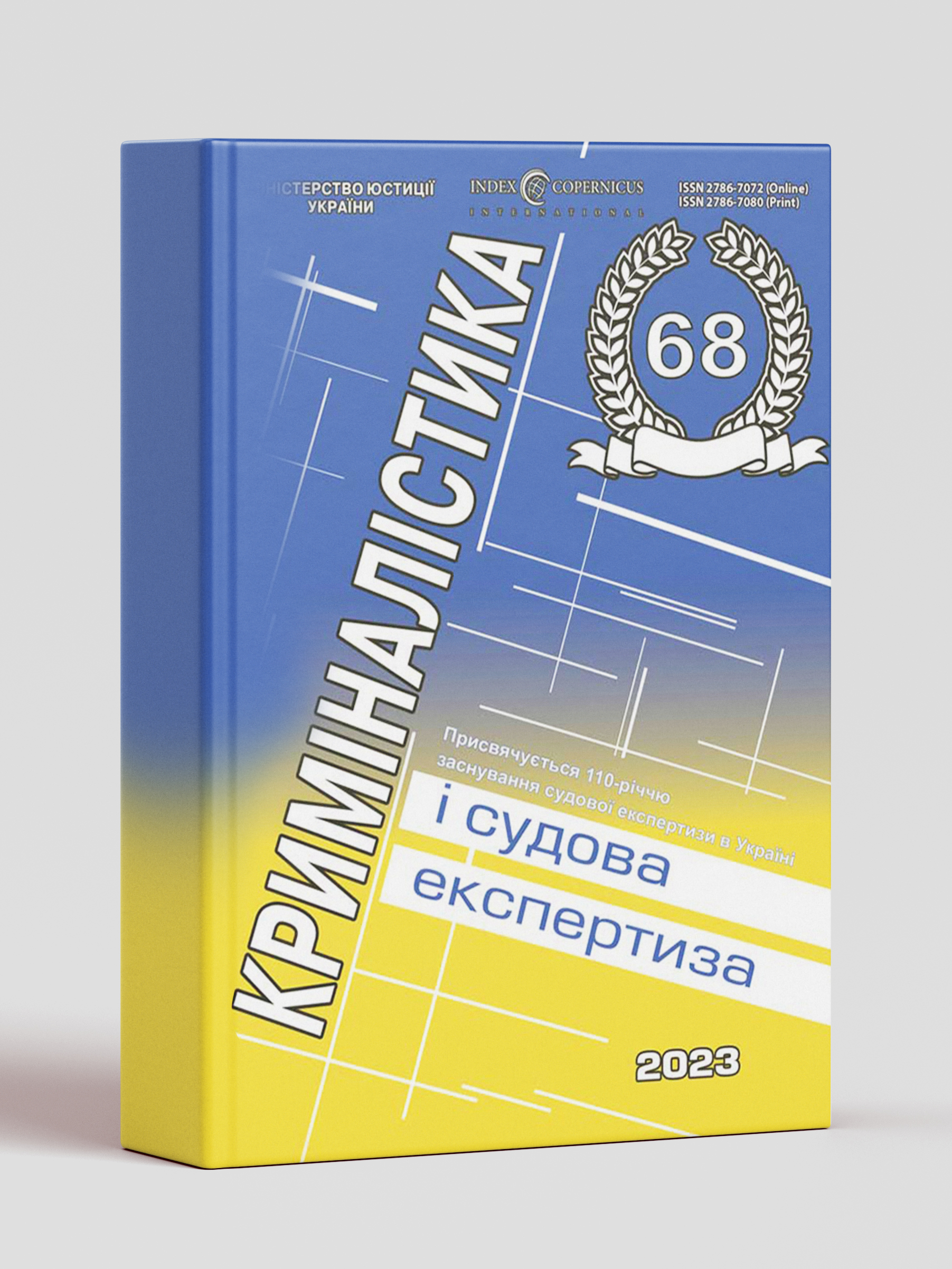
Автором сформульовані концептуальні засади професійної підготовки судово-ветеринарних експертів у державних спеціалізованих експертних ус тановах України. Встановлено, що процес підготовки судово-ветеринарних експертів є технологічно складним, багаторівневим і відповідальним. Свого розвитку він набуває у закладах вищої освіти, які ведуть підготовку лікарів ветеринарної медицини і закінчується у державних експертних закладах Мі ністерства юстиції України, у яких лікар ветеринарної медицини з освітнім ступенем спеціаліст чи магістр, який має намір отримати кваліфікацію су дово-ветеринарного експерта, проходить експертну підготовку за експер тною спеціальністю 18.1 «Ветеринарні дослідження», опановуючи теорети чні, організаційні та процесуальні положення судової експертизи та судово ветеринарної експертизи зокрема, набуває практичних навичок володіння методиками і методичними рекомендаціям; здійснює підготовку проєктів 731 Криміналістика і судова експертиза. Випуск 68 висновків експерта та рецензування проєктів висновків експерта, а також процес атестації та отримує кваліфікацію судового експерта із вище зазна ченої експертної спеціальності, приймає присягу судового експерта, після чого самостійно на професійній основі здійснює судово-експертну діяльність з проведення судово-ветеринарної експертизи. Акцентовано увагу на тому, що особа, яка має намір отримати або під твердити кваліфікацію судового експерта за експертною спеціальність 18.1 «Ветеринарні дослідження» повинна мати виключно вищу ветеринарну освіту, кваліфікацію лікаря ветеринарної медицини ступеня вищої освіти ма гістр або спеціаліст, галузі знань 21 «Ветеринарна медицина», спеціально сті 211 «Ветеринарна медицина». Фахівці, які мають диплом про іншу вищу освіту, крім ветеринарної, претендувати на отримання або підтвердження кваліфікації судового експерта за експертною спеціальність 18.1 «Ветери нарні дослідження» не можуть. Стверджується, що стажування лікарів ветеринарної медицини, що ма ють намір отримати кваліфікацію судово-ветеринарного експерта вперше здійснюється за розробленою нами і затвердженою Міністерством юстиції України програмою № 1 (176 год.), стажування лікаря ветеринарної меди цини, що має намір перший раз підтвердити кваліфікацію судово-ветеринар ного експерта за програмою № 2 (118 год.), стажування лікаря ветеринарної медицини, що має намір другий і наступні рази підтвердити кваліфікацію су дово-ветеринарного експерта здійснюється за програмою № 3 (79 год.). Запропоновано доповнити «Перелік рекомендованої науково-технічної та довідкової літератури» переліком новітніх наукових робіт, опублікованих нами з питань судово-ветеринарної експертизи. На основі аналізу засад підготовки судово-ветеринарних експертів в Ук раїні нами виявлені проблеми у цьому напрямі діяльності, а для їх подолання запропоновано систему конкретних заходів, у т. ч. розробити і впровадити у судово-експертну діяльність «Рейтингову систему діяльності судового ек сперта».
Посилання
Kliuiev, O. M. (2019). Improvement of expert provision of justice: theoretical, legal and organizational aspects. Theory and practice of forensic examination and criminology: collection of scientific papers. Issue 19. P. 102-117. DOI: 10.32353/khrife.1.2019.08 (access date 01.10.2022) (in Ukrainian).
Derecha, L. M. (2021). To the issue of formation of new types of forensic examination. Actual issues of forensic examination and criminology: coll. of the proceedings of international scientific and practical polylogue conference (Kharkov, April 15–16). Kharkiv. P. 146-148 (access date 01.10.2022) (in Ukrainian).
Mulyk, Ya. I. (2021). Organization of training and certification of forensic experts: basic requirements and limitations. Electronic specialist publication «Efficient Economy». No. 1. DOI: 10.32702/2307-2105-2021.1.105 (access date 01.10.2022) (in Ukrainian).
Listos, P., Gryzinska M., Kowalczyk, M. (2015). Analysis of cases of forensic veterinary opinions produced in a research and teaching unit. Journal of forensic and legal medicine. 36. 84-89. DOI: 10.1016/j.jflm.2015.08.002 (in English).
Benetato, M. A., Reisman, R., McCobb, E. (2011). The veterinarian’s role in animal cruelty cases. Javma-journal of the American veterinary medical association. 238. 1. 31-34. DOI: 10.2460/javma.238.1.31 (access date 01.10.2022) (in English).
Yatsenko, I. V., Parylovskyi, O. I. (2020). The latest advances in forensic veterinary examination of animals suffering from cruel treatment. Scientific Bulletin of the S. Z. Gzytskyi Lviv National University of Veterinary Medicine and Biotechnology. Issue 97. P. 95-105. DOI: 10.32718/nvlvet9716 (access date 03.10.2022) (in Ukrainian).
McDonough, S. P., McEwen, B. J. (2016). Veterinary Forensic Pathology: The Search for Truth. Veterinary pathology. 53. 5. Р. 875-877. DOI: 10.1177/0300985816647450 (access date 01.10.2022) (in English).
Arkow, P. (2015). Recognizing and responding to cases of suspected animal cruelty, abuse, and neglect: what the veterinarian needs to know. Veterinary medicine-research and reports.6. P. 349-359. DOI: 10.2147/VMRR.S87198 (access date 01.10.2022) (in English).
Parry, N. M. A., Stoll, A. (2019). The rise of veterinary forensics. Forensic Sci Int.2020. 306:110069. DOI: 10.1016/j.forsciint.110069 (access date 01.10.2022) (in English).
de Siqueira, A., Cuevas, S. E. C. Salvagni, F. A., Maiorka, P. C. (2016). Forensic Veterinary Pathology: Sharp Injuries in Animals. Veterinary pathology. 53. 5. 979-987. DOI: 10.1177/0300985816655850 (access date 01.10.2022) (in English).
Byard, R. W., Boardman, W. (2011). The potential role of forensic pathologists in veterinary forensic medicine. Forensic science medicine and pathology. 7. 3. Р. 231-232. DOI: 10.1007/s12024-011-9241-x (access date 01.10.2022) (in English).
Shcherbakovskyi, M. H.(2015). Conducting and using forensic examinations in criminal proceedings: monograph. Kharkiv. 560 р. (in Ukrainian).
Yatsenko, I. V. (2022). The place of forensic veterinary expertise in the system of forensic expertise and its significance in the judicial process. Eurasian scientific discussions. Proceedings of the 4th International scientific and practical conference. Barca Academy Publishing. Barcelona, Spain. P. 28-39. Retrieved from: https://sciconf.com.ua/iv–mezhdunarodna-ya–nauchno–prakticheskaya–konferentsi-ya–eurasianscientific–discussions–8–10–maya–2022–goda–barselona–ispaniya–arhiv/ (access date 01.10.2022) (in Ukrainian).
Munro, R., Ressel L., Gröne, A., Hetzel, U., Jensen, H. E., Paciello, O., Kipar, A. (2020). European Forensic Veterinary Pathology Comes of Age. J. Comp Pathol.l. 179. P. 83-88. DOI: 10.1016/j.jcpa.2020.08.003 (access date 01.10.2022) (in English).
Cooper, J. E., Cooper, M. E. (2008). Forensic veterinary medicine: a rapidly evolving discipline. Forensic science medicine and pathology. 4. 2. P. 75-82. DOI: 10.1007/s12024-008-9036-x (access date 01.10.2022)(in English).
Ottinger, T., Rasmusson, B., Segerstad, C. H. A., Merck, M., Goot, F. V. D., Olsen, L., Gavier-Widen, D. (2014). Forensic veterinary pathology, today’s situation and perspectives. Veterinary record. 175. 18. 459. DOI: 10.1136/vr.102306 (access date 01.10.2022) (in English).
Cooper, J. E., & Cooper, M. E. (1998). Future trends in forensic veterinary medicine. Seminars in avian and exotic pet medicine. 210-217. https://doi.org/10.1016/S1055-937X(98)80066-2 (access date 01.10.2022) (in English).
Bradley-Siemens, N., Brower, A. I. (2016). Veterinary Forensics: Firearms and Investigation of Projectile Injury. Veterinary pathology. 53. 5. P. 988-1000. DOI: 10.1177/0300985816653170 (access date 01.10.2022) (in English).
Kliuiev, O. M. (2018). International standards and international cooperation in the field of forensic expert activity in Ukraine. Actual issues of forensic examination and criminology: proceedings of the international scientific and practical conference dedicated to the 95th anniversary of the establishment of the Honored Prof. M. S. Bokarius Kharkiv Research Institute of Forensic Expertise. (Kharkiv, October 10–11). Kharkiv. P. 5-8 (in Ukrainian).
Simakova-Yefremian, E. B. (2017). To the question of interdependence of European integration processes and trends of integration of special knowledge in Ukraine. Theory and practice of forensic examination and criminology. Issue 17. Kharkiv. P. 152-158 (in Ukrainian).
Tkachenko, N. M.(2018). Improving the professional training of a forensic expert is an important factor in the development of expert didactics. Theory and practice of forensic examination and criminology. Issue 18. P. 203-214. DOI: https://doi.org/10.323-53/khrife.2018.22 (access date 01.10.2022) (in Ukrainian).
Uhrovetskyi, O. P., Sviderskyi, O. O., Spitsyna, H. O. (2021). Formation of professional mentality of employees of forensic institutions of Ukraine. Actual issues of forensic examination and criminology: coll. of proceedings of international scientific and practical polylogue conference (Kharkiv, April 15–16). Kharkiv. P. 83-85 (in Ukrainian).
Hasparian, S. H. (2018). Ways to improve the quality of personnel training for forensic expert institutions of the Ministry of Justice of Ukraine. Theory and practice of forensic examination and criminology. Issue 18. P. 281-287. DOI: https://doi.org/10.323 53/khrife.2018.31 UDK 343.98:05 (access date 01.10.2022) (in Ukrainian).
Hurov, O. M., Antonov, A. H., Klymenko, M. O., Surhai, N. M., Tatarko, S. V., Dubina, S. O., Uzbek, T. S. (2022). Concept of professional training of forensic medical experts in Ukraine. Forensic medical examination. 2022. No. 1. P. 24-29. DOI: https://doi.org/10.24061/2707-8728.1.2022.3 (access date 01.10.2022) (in Ukrainian).
Holovchenko, L. M. (2016). Problematic issues of training and advanced training of forensic experts in Ukraine. Criminalistics and Forensics. Kyiv. Issue 61. P. 44-51 (in Ukrainian).
Baraniak, V. M. (2014). Problems of training forensic experts in higher educational institutions of Ukraine. Bulletin of the Lviv Polytechnic National University. Legal sciences. 2014. No. 801. P. 229-233. Retrieved from: http://nbuv.gov.ua/UJRN/-vnulpurn_2014_801_41 (access date 01.10.2022)(in Ukrainian).
Kisil, N. V., Hutsul, V. O., Yaroshovets, V. M. (2021). Training of forensic experts in the institutions of the Ministry of Justice of Ukraine: problematic aspects and possible changes in the legislation. Expert: paradigms of legal sciences and public administration: electronic scientific publication: collection. 2021. No. 6 (18). Kyiv. P. 67-78. DOI: 10.32689/2617-9660-2021-6(18)-67-78 (access date 01.10.2022)(in Ukrainian).
Syzonenko, O. A.(2015). Organization of personnel support of forensic and economic examination. Global and national economic problems. 2015. No. 4. P. 1041-1045. Retrieved from: http://global-national.-in.ua/archive/4-2015/218.pdf (access date 01.10.2022) (in Ukrainian).
Hernandez, L. A. H., Luzardo, O. P., Boada, L. D., Gonzalez, M. A., Pena, M. Z. (2015). Introduction of the Problem-based learning methodology in the teaching of Legal Veterinary. Redu-revista de docencia universitaria. 13 (4). 171-188 (in English).
Alieksieichuk, V. I., Starodubov, I. V. (2022). Training of specialists in the field of forensic examination: organizational issues and perspectives. Legal Bulletin. 2022. 2 (63). P. 228-235. DOI: 10.18372/2307-9061.63.16734 (data zvernennia: 01.10.2022) (in Ukrainian).
Yatsenko, I. V. (2022). Forensic veterinary medicine as an educational component for the professional formation of veterinary medicine doctors and its importance in the system of training of forensic veterinary experts in state expert institutions of Ukraine. The I International Scientific and Practical Conference «Current trends in the development of modern scientific thought», September 27-30, Haifa, Israel. P. 182-192. DOI: 10.46299-/ISG.2022.2.1 (access date 01.10.2022) (in Ukrainian).
Regulations on the Central Expert Qualification Commission under the Ministry of Justice of Ukraine and the certification of judicial experts, approved by the order of the Ministry of Justice of Ukraine dated 03.03.2015 No. 301/5 and registered in the Ministry of Justice of Ukraine on March 4, 2015 under No. 249/26694. Retrieved from: https://zakon.rada.gov.ua/laws/show/z0249-15#Text (access date 17.10.2022) (in Ukrainian).
On streamlining the terms of payment and approving the schemes of tariff classes for employees of educational institutions, educational institutions and scientific institutions, approved by the order of the Ministry of Education and Science of Ukraine dated September 26, 2005 No. 557, registered in the Ministry of Justice of Ukraine on October 3, 2005 under No. 1130/11410. URL: https://zakon.rada.gov.ua/laws/show/z1130-05#Text (access date 01.10.2022) (in Ukrainian).
Kurdes, O. V. (2021). Regarding the necessity of starting a mentoring institute in the system of training court experts. Actual issues of forensic examination and crimi-nology: coll. of proceedings of international scientific and practical polylogue conference (Kharkiv, April 15-16). P. 5254 (in Ukrainian).
On Forensic Expertise: Law of Ukraine dated February 25, 1994 No. 4038-XII. Retrieved from: https://zakon.rada.gov.ua/laws/show/4038-12#Text (access date 01.10.2022) (in Ukrainian).
Instructions on the appointment and conduct of forensic examinations and expert studies. Approved by the order of the Ministry of Justice of Ukraine dated 08.10.1998 No. 53/5 (as amended by the order of the Ministry of Justice of Ukraine dated 26.12.2012 No. 1950/5). Retrieved from: https://zakon.rada.gov.ua/laws/ show/z0705-98#Text (access date 01.07.2022) (in Ukrainian).
Instructions on the specifics of forensic expert activity by certified forensic experts who do not work in state specialized expert institutions. Approved by order of the Ministry of Justice of Ukraine dated 12.12.2011 No. 3505/5, registered in the Ministry of Justice of Ukraine on December 12, 2011 under No. 1431/20169. Retrieved from: https://zakon.rada.gov.ua/laws/show/z1431-11#Text (access date 01.03.2022) (in Ukrainian).
Criminal Procedure Code of Ukraine: Law of Ukraine No. 4651–VI. Retrieved from: https://zakon.rada.gov.ua/laws/show/4651-17#Text (access date 01.10.2022) (in Ukrainian).
Civil Procedure Code of Ukraine: Law of Ukraine dated March 18, 2004 No. 1618–IV. Retrieved from: https://zakon.rada.gov.ua/laws/show/1618–15#Text (access date 01.10.2022) (in Ukrainian).
Economic Procedural Code of Ukraine: Law of Ukraine dated November 6, 1991 No. 1798–XII. Retrieved from: https://zakon.rada.gov.ua/laws/show/1798–12#Text (access date 01.10.2022) (in Ukrainian).
Administrative Judicial Code of Ukraine: Law of Ukraine dated 07.06.2005 No. 2747-IV. Retrieved from: https://zakon.rada.gov.ua/laws/show/2747-15#Text (access date 01.10.2022) (in Ukrainian).
Yatsenko, I. V., Parylovskyi, O. I. (2022). Rules of forensic veterinary determination of the degree of severity of damage caused to the health of an animal (methodological recommendations). Kharkiv. 47 p. (in Ukrainian).
Yatsenko, I. V., Parylovskyi, O. I., Kazantsev, R. H. (2021). Methods of forensic veterinary examination of animals for the purpose of establishing their mutilation. Kharkiv. 50 p. (in Ukrainian).
Yatsenko, I. V., Parylovskyi, O. I., Kazantsev, R. H. (2022). Methods of forensic veterinary examination of animal corpses. Kharkiv. 336 p. (in Ukrainian).
Yatsenko, I. V., Parylovskyi, O. I., Kazantsev, R. H. (2021). The procedure for removing objects of forensic veterinary examination from an animal carcass for laboratory research: Methodological recommendations Kharkiv. 51 p. (in Ukrainian).
Yatsenko, I. V., Parylovskyi, O. I., Kazantsev, R. H. (2022). Rules of forensic veterinary examination of animal corpses: methodological recommendations. Kharkiv. 41 p. (in Ukrainian).
Training (internship) programs for forensic experts. / Official website of the Ministry of Justice of Ukraine. Retrieved from: https://minjust.gov.ua/legal_expertise/ program_sudexpert (access date 01.10.2022). Retrieved from: https:// minjust.gov.ua/legal_expertise/program_sudexpert (access date 01.10.2022) (in Ukrainian).
A large explanatory dictionary of the modern language. Retrieved from: https://slovnyk.me/dict/vts/%D0%BD%D0%B0%D0%B2%D0%B8%D1%87%D0%BA%D0%B0 (access date: 10/01/2022).
Fedorenko, V. L., Andrieiev, V. O. (2019). The oath of a forensic expert and the oath of a civil servant in Ukraine: a comparative legal analysis. Expert. No. 2 (4)/8. P. 59-71. DOI: 10.32689/2617-9660-2019-4-2-59-72 (access date 01.10.2022) (in Ukrainian).
The procedure for maintaining the Register of methods of conducting forensic examinations, approved by the order of the Ministry of Justice of Ukraine dated October 2, 2008 No. 1666/5, registered in the Ministry of Justice of Ukraine on October 2, 2008 under No. 924/15615. Retrieved from: https://zakon.rada.gov.ua/laws/show/z0924-08#Text (access date 01.10.2022) (in Ukrainian).
The list of recommended scientific and technical and reference literature used during forensic examinations, approved by order of the Ministry of Justice of Ukraine dated July 30, 2010 No. 1722/5. Retrieved from: https://zakon.rada.gov.ua/laws/show/v1722323-10#Text (access date 01.10.2022) (in Ukrainian).