
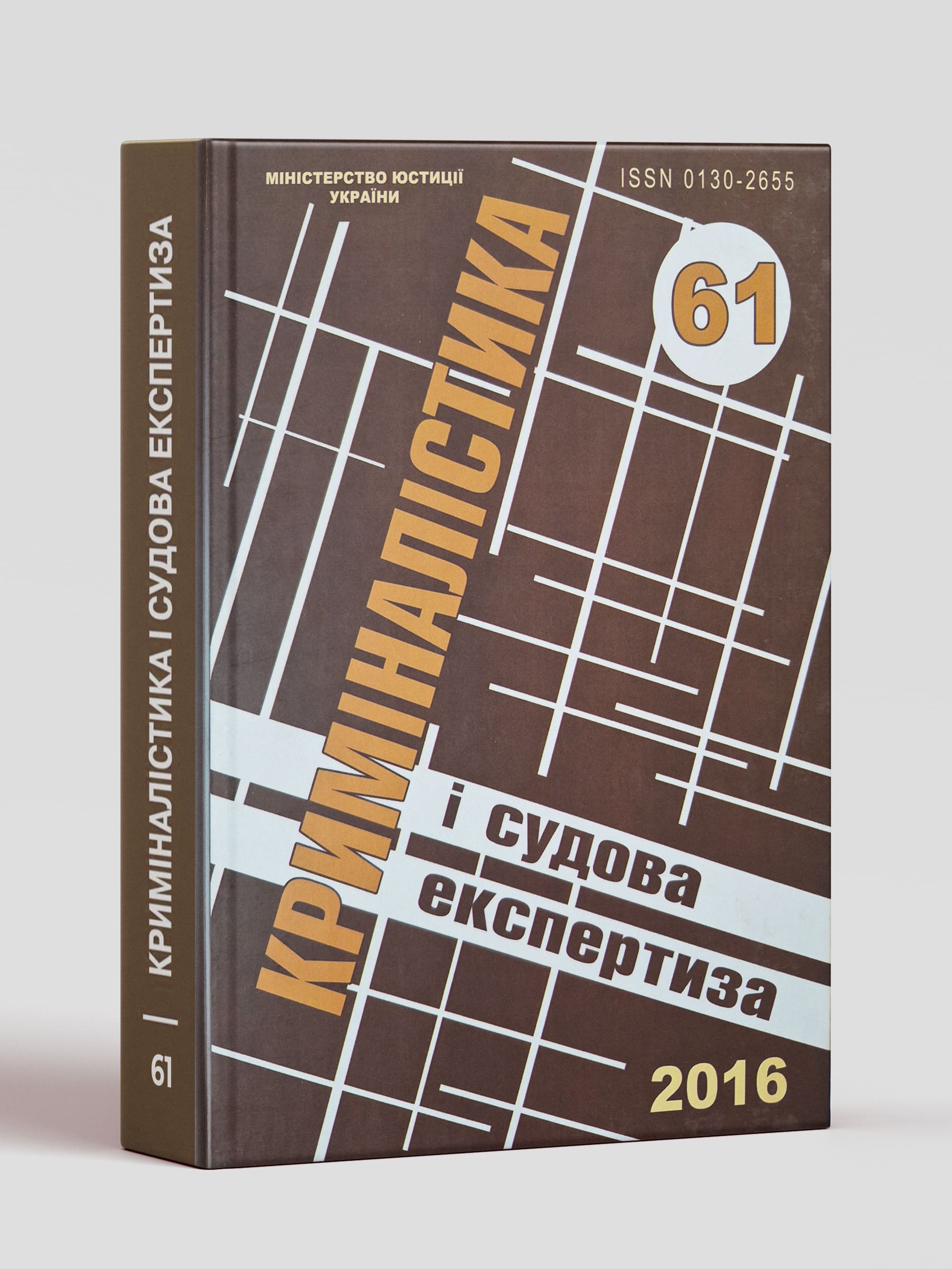
How to Cite
Abstract
The commission of serious crimes involving firearms presently considering conducting ATO, unfortunately, not uncommon. And the evidence - guns, bullets, shells - are investigated, usually with different modifications comparative microscopes. But this is not enough. Indeed, in 1998 a famous scientist and criminologist Ukraine, Senior Fellow Research Institute to combat crime problems of the National Academy of Internal Affairs Y.I. Fedorenko invented a unique device that allows you to work much more efficiently with real evidence. Today it is common knowledge - that if in the act are ball or sleeve, then to identify the firearm that was used, and after that deleted one step. Indeed, these arguments can determine what kind of weapon was used, and traced its way from the manufacturer to the owner. However, this process is far from simple. Seized from the scene bullets and cartridge cases are sent to provincial NDEKTS where they investigate to determine the characteristics of trails (traces from the inner surface of the bore and the other parts of the weapons). Then check the "repetition" - or was not previously used the weapons in the commission of other crimes. If the result is negative, the evidence sent to the State Research Center Forensic MIA of Ukraine. This work is complex and time-consuming. For example, the identification of one, liners (balls) spent up to eight hours (in difficult cases, and more), as well as to study the bullets and shells still - has for decades mostly used different versions comparative microscopes (except for "THAIS" , "REBOUND"). This error is not excluded as a result of imperfection of the optical microscope system. Also significantly tightened deadlines identification expertise. The idea to create a device that would help maximize investigation, was born in Y. Fedorenko in 1993. Then he worked with sources of nuclear radiation in another area, but decided to try to apply in the forensic field, namely in the judicial ballistics. As a result, created a technical device, which later became known as "workstations" "КORID" (corpuscular ID). This is a device that scans, absolutely safe, portable and compact. Within 15-20 minutes, the computer screen displays a three-dimensional image of the surface of the developed world - and any inspector or police criminalist-expert receives reliable information on firearms that have been used or applied. To use this appliance requires minimal special training. Currently existing microscopes comparative weighing several dozen kilograms, not compact, not portable and are considerably more expensive. Analogues "КORID" in the world there. Before the device was shown significant interest internationally. Representatives of one of the developed countries offered the author the right to sell the idea and production of this device. Prototype "КORID" has been tested in practice. In the 90’s was shot family Krivoruchko. To prove the guilt of the suspect seemed very problematic, removed his pistol was antique and the bore had a large degree of wear, the traditional method of research for the identification gun were found at the murder bullets seemed impossible. Investigators asked the Y.I. Fedorenko - by using the "КORID" was held with the identification studies strongly positive conclusions. An interesting detail is also "hidden" opportunities "КORID" at work not only with bullets and shells, but also with other physical evidence - including coins, tools and hacking etc. So based on the above-mentioned consider it appropriate to consider a more detailed structure, operating principle and features "bullfighting".
References
Klevtsov O. O. Ukraynskyy uchenyy krymynalyst otkazalsya prodatʹ ynostrannym spetssluzhbam svoe yzobretenye za myllyon dollarov // Fakty. 2001. Vyp. 15.08.01. S. 21.
Fedorenko YU. I., Massalʹsʹkyy H. YE., Payushchyk I. I. Identyfikatsiya nariznoyi vohnepalʹnoyi zbroyi metodom reyestratsiyi rozsiyanoho korpuskulyarnoho vyprominyuvannya: prakt. posibnyk. Kyyiv, 2001. 72 s.