
Keywords
explosives
explosive devices
weapons
illegal manufacture of ammunition
explosive expertise
How to Cite
Abstract
One of the subjects of criminal encroachment in the commission of a crime under Art. 263-1 of the Criminal Code of Ukraine are ammunition, explosives and explosive devices. Such objects are capable of causing destruction, have the ability to cause bodily injury or death to a person and form significant material harm. At the present stage, in the absence of a basic law on weapons, in practice, there are certain problems with the qualification of the acts of persons as the illegal manufacture of ammunition, explosives and explosive devices. The article presents the concepts and types of these elements of the forensic characteristics of a crime under Art. 263 1 of the Criminal Code of Ukraine. The classification of ammunition, explosives and explosive devices makes it possible to differentiate a specific object as the subject of a crime under Art. 263-1 of the Criminal Code of Ukraine, to determine its forensically significant properties and characteristics. Particular attention is paid to traces that appear at the site of careless handling of ammunition, explosives and explosive devices. To inspect the sites of these incidents, it is imperative to involve specialists in ballistics, explosives specialists, as well as other persons with special knowledge in the field of ballistics and explosives. The presence of these specialists also ensures the safety of other participants in this investigative action. Ammunition, explosives and explosive devices as objects of criminal assault have a close relationship with the personality of the offender, the method of committing a criminal offence and the pattern of traces. Therefore, the establishment of the objects of criminal encroachment and their study allow you to correctly select the methods, techniques and means of investigation, determine the optimal sequence of investigative actions, and also properly ensure the investigation of a crime under Art. 263-1 of the Criminal Code of Ukraine. The article concludes with the importance of ammunition, explosives, and explosive devices for establishing the elements of a forensic characterization of a crime under Art. 263-1 of the Criminal Code of Ukraine, and the need to use the special knowledge of experts involved in the relevant criminal proceedings.
References
Kofanov, A. V., Yusupov, V. V., Mykhalchuk, T. V. (2021). Legal regulation of weapons circulation: history, current state and development prospects: monograph. Kharkiv. 608 p. (in Ukrainian).
Voluyko, O. M., Romashko, O. M., Lehenkyi, V. V. (2020). Peculiarities of the criminal law counteraction to the illegal circulation of weapons, ammunition and explosives in the activities of law enforcement agencies of Ukraine. Legal bulletin. Issue. 16. Р. 233-240. DOI: https://doi.org/10.32850/lb2414-4207.2020.16.31 (in Ukrainian).
Voloboiev, A. O. (2019). Illegal handling of weapons and ammunition: theoretical and legal aspect. Problems and prospects of the development of modern science in the countries of Europe and Asia: proceedings of the XIII International scientific and practical Internet-conference (Pereiaslav-Khmelnytskyi, February 28). Pereiaslav-Khmelnytskyi. P. 121-123 (in Ukrainian).
Vitvitskyi, S. S., Volobuieva, O. O., Voloboiev A. O., (2021). Methods of investigating illegal handling of weapons and ammunition: monograph. Kyiv. 308 p. (in Ukrainian).
Peretiatko, S. A. (2021). Method commis-sion of illegal manufacture, processing or repair of firearms or fraud unlawful removal or changes its labelling or illicit manufacture of ammunition, explosives or explosive devices. Scientific Journal of the National Academy of Internal Affairs. 26 (4). Р. 22-30. DOI: 10.33270/01211214.22 (in English).
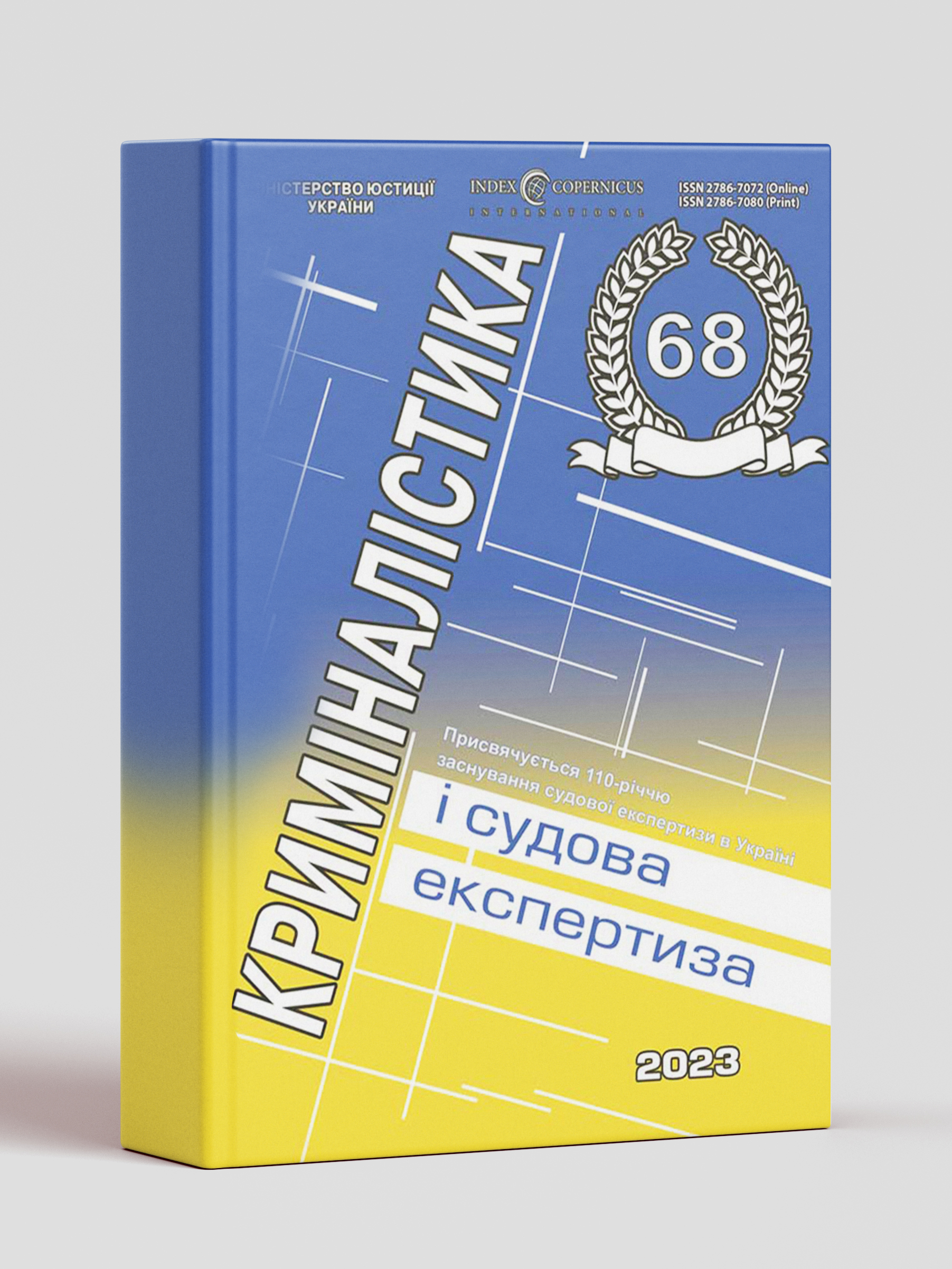
Peretiatko, S. A. (2022). Problems of appointing and conducting an examination during the investigation of criminal offenses provided for by Art. 263-1 of the Criminal Code of Ukraine. Criminalistics and Forensics. Issue. 67. P. 114-123. DOI: https://doi.org/10.33994/kndise.2022.67.13 (in Ukrainian).
Bereza, Yu. M., Yefimov, M. M., Kono-nets, V. P., Novosad, A. S. et al. (2020). Criminal liability for illegal arms trafficking: a monograph. Dnipro. 364 p. (in Ukrainian).
Melnyk, M. I., Havroniuk, M. I. (Eds.) (2019). Scientific and practical commentary on the Criminal Code of Ukraine. Kyiv. 1384 p. (in Ukrainian).
On the approval of the standard of the Ministry of Internal Affairs of Ukraine SOU 78-19-001:2007 «Pistols, revolvers and other short-barreled non-lethal devices. General technical conditions»: order of the Ministry of Internal Affairs of Ukraine dated 29.08.2007 No. 325 (as amended and supplemented by order of the Ministry of Internal Affairs of Ukraine dated 26.10.2017 No. 882). Kyiv. 42 p. (in Ukrainian).
On the approval of the Instructions on the procedure for the manufacture, acquisition, storage, accounting, transportation and use of firearms, pneumatic, cold and cooled weapons, devices of domestic production for firing cartridges, equipped with rubber or similar in their properties metal projectiles of non-lethal action and cartridges for them, as well as ammunition for weapons, main parts of weapons and explosive materials: order of the Ministry of Internal Affairs of Ukraine dated 21.08.1998 No. 622. Retrieved from: https://zakon.rada.gov.ua/laws/show/z0637-98 (access date 06.04.2023) (in Ukrainian).
On judicial practice in cases of kidnapping and other illegal handling of weapons, ammunition, explosives, explosive devices or radioactive materials: Resolution of the Plenum of the Supreme Court of Ukraine dated 26.04.2002 No. 3. Retrieved from: https://zakon.rada.gov.ua/rada/show/v0003700-02 (access date 06.04.2023) (in Ukrainian).
Kyrychenko, O. A. (2013). Basic signs, concepts and classification of criminal weapons: lecture. Mykolaiv. 348 p. (in Ukrainian)
Pashchenko, V. I., Kobets, M. V., Ishchenko, A. V. et al.(2010). Means and methods of countering terrorist acts com-mitted with the use of explosive devices: educational and practical manual. Kyiv. 159 p. (in Ukrainian).
Kobets, M. V. (2007). Explosive devices: improvement of interpretation and classifi-cation in explosive examination. Crimina-listics Herald. No. 1 (7). P. 139-144 (in Ukrainian).
Prokhorov-Lukin, H. V., Pashchenko, V. I., Bykov, V. I. et al. (2011). Methodology of complex research of explosive devices, explosive substances and explosion traces. Kyiv. 216 p.(in Ukrainian).
Areshonkov, V. V., Antoniuk, P. Ye., Antoshchuk, A. O. et al. (2020). Criminalistics: multimedia textbook. Kyiv. Retrieved from: http://elar.naiau.kiev.ua/jspui/handle/123456789/19880 (access date 06.04.2023) (in Ukrainian).