
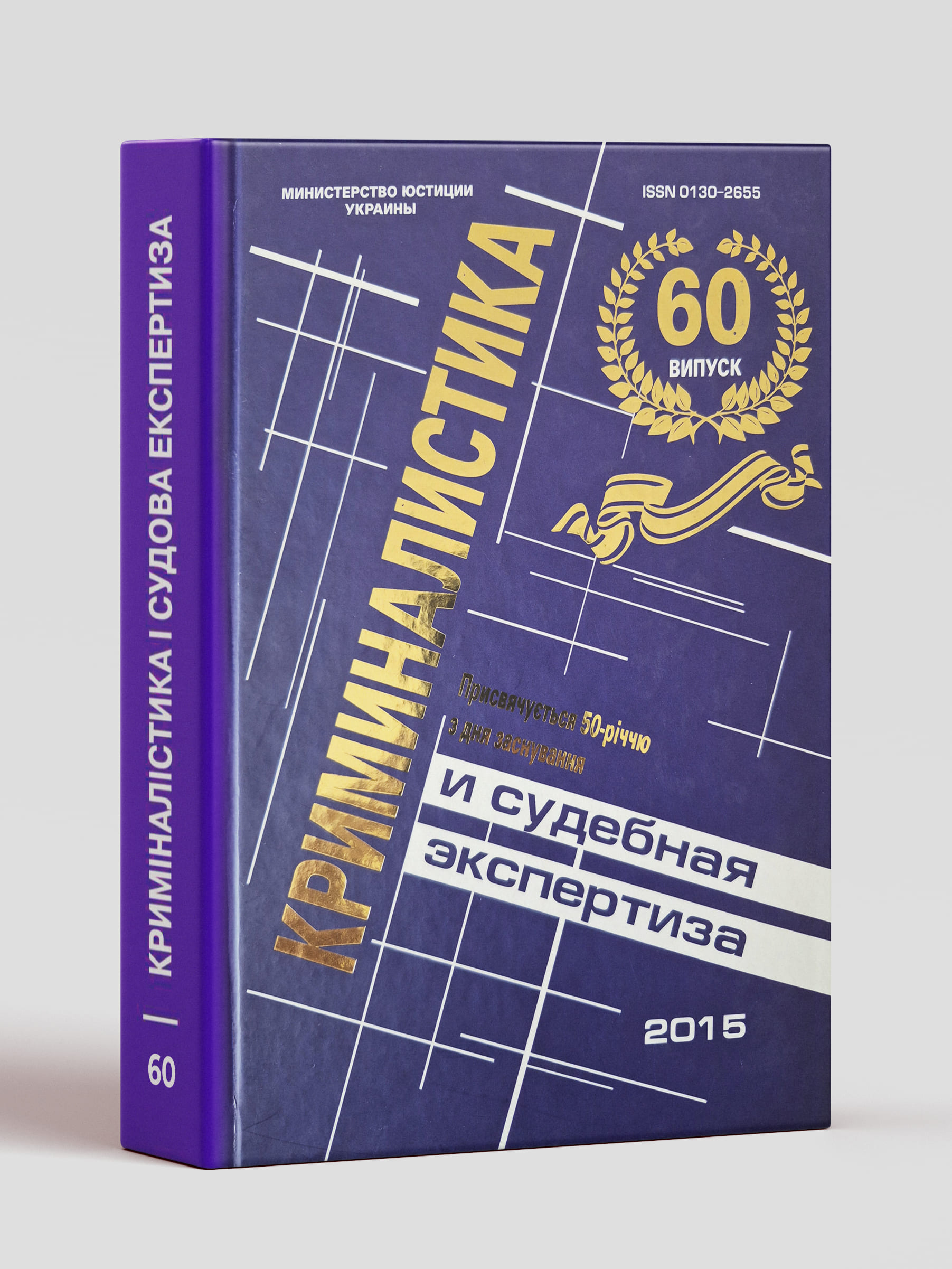
Keywords
How to Cite
Abstract
The open and adversarial nature of court proceedings in modern Ukraine, along with extensive media coverage, requires forensic methodologies to be clear and understandable not only to experts, but also to law enforcement officers, defense counsel, judges, trial participants, and journalists.
An expert report serves as a source of evidence rather than standalone proof. To be evaluated as admissible evidence during pre-trial or trial proceedings, expert findings must rely on scientifically grounded, objective methods and techniques that feature clear and unambiguous definitions, presented consistently and logically for judicial evaluation. In this context, the theories of criminalistic identification and forensic expertology serve a crucial methodological function in developing forensic techniques—a key stage in objectifying expert experience and acquiring new knowledge.
The absence of a formal legal education among non-forensic specialist experts must be offset by specialized interdisciplinary training that incorporates essential legal knowledge. This foundation should cover relevant subfields of substantive law (criminal, civil, administrative), procedural rules governing forensic examinations and their judicial evaluation, criminalistics, and forensic expertology. Crucially, this training must also include scientific methodology, logic, and academic writing. Regrettably, current retraining programs in Ukraine for non-forensic specialists largely neglect these areas.
Systematic training would minimize conceptual inconsistencies regarding fundamental notions—such as "property," "trait/feature," "classification of traits," "expert task," and "types of expert tasks"—frequently found in newly developed methodologies. Addressing these gaps would significantly strengthen the evidentiary value of both forensic methodologies and the resulting expert opinions.
In light of these issues, this paper analyzes epistemological and logical errors in criminalistics and forensic literature as well as existing forensic methodologies, offering practical recommendations for their prevention.
References
Vinberg A. I. O printsipakh klassifikatsii ob"yektov v sudebno-ekspertnoy ob"yektologii / A. I. Vinberg, N. T. Malakhovskaya // Metodologiya sudebnoy ekspertizy. — M., 1986. — S. 27–40.
Vinberg A. I. Sudebnaya ekspertologiya (obshcheteoreticheskiye i metodologicheskiye problemy sudebnykh ekspertiz): ucheb. posobiye / A. I. Vinberg, N. T. Malakhovskaya. — Volgograd, 1979. — 181 s.
Klymenko N. I. Sudova ekspertolohiya: kurs lektsiy: navch. posib. dlya stud. yuryd. spets. vyshch. navch. zakl. / N. I. Klymenko. — K.: Vydavnychyy Dim «In Yure», 2007. — 528 s.
Kondakov N. I. Logicheskiy slovar'-spravochnik / N. I. Kondakov. — M.: Nauka, 1975. — 717 s.
Kryminalistyka: pidruchnyk / za red. P. D. Bilenchuka. — 2-he vyd., vypr. i dop. — K.: Ataka, 2001. — 544 s.: il.